Some observations.
For this morning's dog walk I had to wait a few minutes to cross Lake Ave by McCough's. There were five cars waiting to turn right at the stop sign.
Taking the kids to daycare at 8:15 I had to wait to be let out of the alley between Eighth and Ninth St. Of about 10 cars that were heading north on Cass eight continued downtown (including me).
Last night at 10 PM there were no cars on Cass, Eighth, or Lake Ave. I know because I stood in the middle of the street waiting a few minutes for the dog to finish sniffing whatever it was he was sniffing.
So... is a lot of traffic a couple times per day, and only on weekdays (not weekends) in need of a $5+ million solution?
Isn't Lake Ave already used as a bypass for Cass and Union streets, making it easier for 80% of the cars using Cass to go downtown?
Showing posts with label braess. Show all posts
Showing posts with label braess. Show all posts
Monday, February 28, 2011
Tuesday, February 22, 2011
Road Flares
When you are on the road and have a problem you light a flare to send a signal. What signal will Traverse City send?
When the barn on Lake Avenue was burning earlier this winter the Traverse City Fire Department woke up all the neighbors at 2:30 AM by banging on doors and telling them to get ready to evacuate. The TCFD made the decision to let this barn burn rather than risk contaminating the Boardman River with the fertilizer stored inside. How is that for foresight? My neighbors and I loved that barn, but we also love that the TCFD made that decision. A barn, or even our houses, are temporary and can be rebuilt, the Boardman River will outlast us and cannot be redone.
What does the community value?
My wife and I moved here in 1999. There were signals that drew us here. The wind turbine on M-72 was new, Outside Magazine had just named the area a top destination. We visited with the goal of making Traverse City our permanent home. We camped at DH Day and drove slowly through the leafy neighborhoods looking at rentals. We saw that Traverse City was the ideal mix of urban and un-paved spaces. We saw signs that Traverse City was starting a wave we wanted to ride.
Look at this picture from Anderson Aerial Photography (visit the link for a huge version of the file).
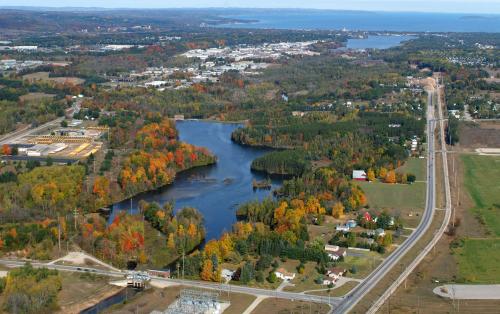 What a place! My wife and I feel fortunate that we have been able to make a life here.
When you look at the area from the air the Boardman River is like a necklace draped over the landscape, giving the community a jewel to appreciate amidst the urban fabric.
I value that in-town Boardman Lake supports mink, beaver, red winged blackbirds, fox, bobcats, swans, loons, buffleheads, and a wide variety of sport fishing opportunities. Doesn't everyone get some pride out of telling out-of-town friends that we can hear loons - from downtown! Where else would this be possible?
What does the community value?
More car capacity or more capacity for the things people enjoy?
This winter I have seen my neighbors using the area where the Boardman Lake Avenue will go as an impromptu sledding hill; a safe space for teaching children how to XC ski; a play area for people and their dogs. Spring is coming and one of my favorite things on the first nice day is to grab a snack at Oryana followed by a walk over to Boardman Lake while experiencing the warm sunshine and the first red-winged blackbirds of the year.
This is what I value.
But now the City is calling this the West Boardman Lake Re-development project. I feel as though the City is appealing to our values by re-badging a road building project as parks and trails and we'll just throw a road in there for good measure. Thus I have become skeptical of the entire process. I have the sense that the City has already decided that a road is going to be built and all that matters now is how.
Though I am skeptical of a new road I am proud of my neighborhood. I am thankful to live in neighborhood where there is a small number of residents who care enough for the health and safety of their neighbors that they volunteer their time to make our neighborhood a better place. It is difficult for families with two careers, two kids, social engagements, and many other commitments to make it to the Neighborhood Association meetings so their dedication is appreciated. But Neighborhood Associations are not elected bodies, and never did I think they were decision making entities. Perhaps I missed it but I was never given a survey about my thoughts for a Boardman Lake Avenue. I never saw a neighborhood meeting where the pros and cons of a new road were discussed.
Because the dedicated tiny band of volunteers who are our Old Town Neighborhood Association were promised a road, they weren't promised a solution. The assumption was made that they were equivalents so the discussion never came up. But a road is not a solution.
Those of us who are in opposition to a road want the same thing as those who were promised a road - we all want a solution to traffic speeding through our neighborhood. It is well known in Engineering Departments that adding roads decreases overall traffic efficiency. They know about the Braess Paradox. Why didn't anyone tell the Old Town Neighborhood Association?
I am not opposed to building Boardman Lake Avenue to be divisive, I oppose it because I love my neighborhood and my neighbors and I want the best solution for all of us - all of us in Old Town and in Traverse City.
I want to find a traffic solution that signals to everyone that we develop our city for people, not cars.
I want to signal that we value financial responsibility, the well-being of our residents, and the health of our land and waters.
A flare is not only a signal to "come here", but it can also be a warning. These arguments are some of my road flares:
-History: Ask yourself this - if there's too much traffic going through your neighborhood what is the better solution, creating more capacity for more cars or making it easier for traffic to go around your neighborhood (e.g., on S Airport Rd)? History shows that a community has NEVER built a road like Boardman Lake Avenue and seen a decrease in traffic in the neighborhood.
-Financial: once the road is built the brownfield money spent on it is no longer available for any other projects. Where does the money come from when residents in Slab Town and Traverse Heights demand solutions too? How does Traverse City justify on-going maintenance costs of a new road while other streets are in need of repair and modernization, and with the City facing a $30+ million pension shortfall?
-Safety: A new traffic signal where Copy Central and Midtown are will lead to more congestion and more access points onto Eighth St. More access points create more opportunities for accidents.
Pedestrians who want to access Boardman Lake Trail will now have an additional road to cross, and a road that will be designed for a high volume of traffic. This will make it difficult for families who bike from Oryana to the Boardman Lake trail to do so without risking a conflict with a speeding vehicle.
-Health: There is known contamination between Cone Drive and Boardman Lake. Another unknown is how much more pollution will be encountered, therefore the remediation costs are unknown. And if this corridor is polluted who will build there? Plus, excavating through contaminated soil will threaten Boardman Lake. This road will increase salt and sediment runoff into Boardman Lake too.
And for Midtown residents, an extra traffic light here will lead to more waiting traffic polluting their air.
Traverse City has a chance here to reject the failed road building policy from the past and embrace a solution that makes the neighborhoods more livable.
Consider...
Would we build Eighth St the same way today? Would we bisect the City with a four lane street that pedestrians cannot cross?
Would we build Grandview Parkway the same way today? I think that if we were given the chance to do it over we would not cut ourselves off from the Bay.
Would we build Division St the same way today so that this busy street blocks pedestrian access to 500 acres of parkland?
So why would we try to build a new street that will block easy access to Boardman Lake, the library, and the Boardman Lake trail? Is that what we value?
I believe that we value solutions.
Traffic is like a giant bucket of water. Or a dam with an insatiable amount of water trying to get over it. You start with some trickles of water coming from a few holes. You make new holes and the water doesn't come out of those existing holes any more slowly, but you do get your feet wetter a whole lot quicker. Add more roads and all we'll end up with is a flood of traffic.
Add more capacity for people and we signal the reasons why we love living in Traverse City.
[this was Part 3 of what ended up being a three part series. Earlier posts are
Part 1: Traffic is a Gas
Part 2: You Can't Undo A Road]
When the barn on Lake Avenue was burning earlier this winter the Traverse City Fire Department woke up all the neighbors at 2:30 AM by banging on doors and telling them to get ready to evacuate. The TCFD made the decision to let this barn burn rather than risk contaminating the Boardman River with the fertilizer stored inside. How is that for foresight? My neighbors and I loved that barn, but we also love that the TCFD made that decision. A barn, or even our houses, are temporary and can be rebuilt, the Boardman River will outlast us and cannot be redone.
What does the community value?
My wife and I moved here in 1999. There were signals that drew us here. The wind turbine on M-72 was new, Outside Magazine had just named the area a top destination. We visited with the goal of making Traverse City our permanent home. We camped at DH Day and drove slowly through the leafy neighborhoods looking at rentals. We saw that Traverse City was the ideal mix of urban and un-paved spaces. We saw signs that Traverse City was starting a wave we wanted to ride.
Look at this picture from Anderson Aerial Photography (visit the link for a huge version of the file).
What a place! My wife and I feel fortunate that we have been able to make a life here.When you look at the area from the air the Boardman River is like a necklace draped over the landscape, giving the community a jewel to appreciate amidst the urban fabric.
I value that in-town Boardman Lake supports mink, beaver, red winged blackbirds, fox, bobcats, swans, loons, buffleheads, and a wide variety of sport fishing opportunities. Doesn't everyone get some pride out of telling out-of-town friends that we can hear loons - from downtown! Where else would this be possible?
What does the community value?
More car capacity or more capacity for the things people enjoy?
This winter I have seen my neighbors using the area where the Boardman Lake Avenue will go as an impromptu sledding hill; a safe space for teaching children how to XC ski; a play area for people and their dogs. Spring is coming and one of my favorite things on the first nice day is to grab a snack at Oryana followed by a walk over to Boardman Lake while experiencing the warm sunshine and the first red-winged blackbirds of the year.
This is what I value.
But now the City is calling this the West Boardman Lake Re-development project. I feel as though the City is appealing to our values by re-badging a road building project as parks and trails and we'll just throw a road in there for good measure. Thus I have become skeptical of the entire process. I have the sense that the City has already decided that a road is going to be built and all that matters now is how.
Though I am skeptical of a new road I am proud of my neighborhood. I am thankful to live in neighborhood where there is a small number of residents who care enough for the health and safety of their neighbors that they volunteer their time to make our neighborhood a better place. It is difficult for families with two careers, two kids, social engagements, and many other commitments to make it to the Neighborhood Association meetings so their dedication is appreciated. But Neighborhood Associations are not elected bodies, and never did I think they were decision making entities. Perhaps I missed it but I was never given a survey about my thoughts for a Boardman Lake Avenue. I never saw a neighborhood meeting where the pros and cons of a new road were discussed.
Because the dedicated tiny band of volunteers who are our Old Town Neighborhood Association were promised a road, they weren't promised a solution. The assumption was made that they were equivalents so the discussion never came up. But a road is not a solution.
Those of us who are in opposition to a road want the same thing as those who were promised a road - we all want a solution to traffic speeding through our neighborhood. It is well known in Engineering Departments that adding roads decreases overall traffic efficiency. They know about the Braess Paradox. Why didn't anyone tell the Old Town Neighborhood Association?
I am not opposed to building Boardman Lake Avenue to be divisive, I oppose it because I love my neighborhood and my neighbors and I want the best solution for all of us - all of us in Old Town and in Traverse City.
I want to find a traffic solution that signals to everyone that we develop our city for people, not cars.
I want to signal that we value financial responsibility, the well-being of our residents, and the health of our land and waters.
A flare is not only a signal to "come here", but it can also be a warning. These arguments are some of my road flares:
-History: Ask yourself this - if there's too much traffic going through your neighborhood what is the better solution, creating more capacity for more cars or making it easier for traffic to go around your neighborhood (e.g., on S Airport Rd)? History shows that a community has NEVER built a road like Boardman Lake Avenue and seen a decrease in traffic in the neighborhood.
-Financial: once the road is built the brownfield money spent on it is no longer available for any other projects. Where does the money come from when residents in Slab Town and Traverse Heights demand solutions too? How does Traverse City justify on-going maintenance costs of a new road while other streets are in need of repair and modernization, and with the City facing a $30+ million pension shortfall?
-Safety: A new traffic signal where Copy Central and Midtown are will lead to more congestion and more access points onto Eighth St. More access points create more opportunities for accidents.
Pedestrians who want to access Boardman Lake Trail will now have an additional road to cross, and a road that will be designed for a high volume of traffic. This will make it difficult for families who bike from Oryana to the Boardman Lake trail to do so without risking a conflict with a speeding vehicle.
-Health: There is known contamination between Cone Drive and Boardman Lake. Another unknown is how much more pollution will be encountered, therefore the remediation costs are unknown. And if this corridor is polluted who will build there? Plus, excavating through contaminated soil will threaten Boardman Lake. This road will increase salt and sediment runoff into Boardman Lake too.
And for Midtown residents, an extra traffic light here will lead to more waiting traffic polluting their air.
Traverse City has a chance here to reject the failed road building policy from the past and embrace a solution that makes the neighborhoods more livable.
Consider...
Would we build Eighth St the same way today? Would we bisect the City with a four lane street that pedestrians cannot cross?
Would we build Grandview Parkway the same way today? I think that if we were given the chance to do it over we would not cut ourselves off from the Bay.
Would we build Division St the same way today so that this busy street blocks pedestrian access to 500 acres of parkland?
So why would we try to build a new street that will block easy access to Boardman Lake, the library, and the Boardman Lake trail? Is that what we value?
I believe that we value solutions.
Traffic is like a giant bucket of water. Or a dam with an insatiable amount of water trying to get over it. You start with some trickles of water coming from a few holes. You make new holes and the water doesn't come out of those existing holes any more slowly, but you do get your feet wetter a whole lot quicker. Add more roads and all we'll end up with is a flood of traffic.
Add more capacity for people and we signal the reasons why we love living in Traverse City.
[this was Part 3 of what ended up being a three part series. Earlier posts are
Part 1: Traffic is a Gas
Part 2: You Can't Undo A Road]


Thursday, February 17, 2011
You Can't Undo A Road
Once a new road is built it will be there for a lifetime.
If it ends up being a mistake it becomes a very expensive mistake that the City has to subsidize. Roads, like parking, are an entitlement that once established cannot be rolled back. Best to avoid them in the first place.
Boardman Lake Avenue should be a last resort, not a first option.
If the concern is about traffic through the neighborhood then should the City make it easier for traffic to flow around the neighborhoods? Or should Traverse City add an extra path for traffic to use through the neighborhoods?
We all want to do something about traffic through our neighborhoods. I am not opposed to doing something to make the flow of traffic safer but I am opposed to a solution that will exacerbate the problems the neighborhoods face.
If someone can show me an example of where a new road like Boardman Lake Ave has helped then I would be happy to revise my opinion. But I have to base my opinion on the facts, and they are that roads such as this do not alleviate traffic congestion.
Here are the possible scenarios I see for Boardman Lake Avenue if it is built:
A: Boardman Lake Avenue works as advertised. Although there are no historical examples of this ever happening I'll indulge in a little fantasy. Cass between 14th and 8th is only used by local traffic and people wanting to go downtown take the long way of the new road. But if this is the case then we have a high speed (I know people say it will be 25 mph but 8th St is 25 mph too) high volume road sitting between Old Town and Boardman Lake and the library. People who used to walk to the library will now be intimidated by this road crossing and hence drive to the library.
Riverside Apartments becomes a local crash zone as pedestrians, bicyclists, and drivers try to negotiate multiple intersections on Eighth St.
Other residential areas such as W Front St demand action to the traffic that bakes up in front of their houses every day. Slab Town and Traverse Heights neighborhoods demand that the City do something about the cut-through traffic.
And they have a point. If the City is going to build a road for a few people in Old Town then every other neighborhood has a right to demand a similar solution to their traffic problem.
B: Boardman Lake Avenue is built and since most people are heading downtown, most people do not use it. The result is a multi-million dollar road to nowhere.
C: Boardman Lake Avenue is built as the West Boardman neighborhood. New houses and businesses are built. Not too much changes. The neighborhood just gets a little bigger, the City gets a little bigger tax base.
Problem with this scenario is I don't see how there's that much room for a new neighborhood, plus who would choose to live between Cone Drive and Boardman Lake when there is a know contaminated groundwater plume between the two?
D: Boardman Lake is built and Braess's Paradox takes over. Most people initially use the new road, but as the new road becomes busy drivers switch to Cass in an attempt to find a better route. Other drivers try the roads and finding neither overly congested start using Boardman Lake Ave and Cass more often. This leads to more traffic using 14th. More traffic on 8th. It becomes more difficult to drive anywhere in town because of the increased traffic volume that the new road has enabled. It becomes more difficult to walk from Old Town neighborhood to anywhere because high volume/speed roads have caged it in.
People complain that there's too much traffic. The City tries various traffic calming measures as they are the only remaining resource to deal with the situation.
History shows Scenario D is the predictable outcome.
Now consider a scenario where the entire traffic system is considered. Where road planning is done from a high level and for the good of the Community, not just one neighborhood.
The world is lazy. Capitalize on the laziness of people. Equilibrate and optimize traffic so that staying out of the neighborhoods becomes the lazy way to drive around and everyone can find happiness with the situation.
Think of the system.
I think about Pac Man - gobbling up dots around the outside edge of the screen - that is how I think about traffic going around the outside of the neighborhoods rather than through them.
Right now it is easier to drive through the neighborhoods. Why would we add another road to neighborhoods then? To make it even easier?
I think it is easier to edit than create so I am going to present my City wide traffic system plan as a starting point for others to edit and destroy:
-S. Airport Rd has to be a better east-west route with fewer stops and starts. There are so many stop lights there that it has become a hurry up and wait track.
The traffic light by Logan's Landing has been a disaster in my opinion. Auntie Pasta's has closed. The YMCA is going to move their main building. Rather than a traffic light here put in "Michigan left's" down by Goodwill and by Verizon. Recent research shows eliminating normal left hand turns can make a great improvement in traffic flow.
See:
Smithsonian: Life Without Left Turns
NCSU: Operational Effects of Signalized Superstreets in North Carolina.
-Are traffic lights needed at both Barlow and Park Dr? Remove access to Park Dr from S Airport Rd.
-Re-align Barlow - Woodmere - Railroad Ave with a roundabout at E 8th for an additional way into downtown.
-Division St needs to be a boulevard in the same kind of transformation that Woodmere Ave saw. Go from four lanes to two with "Michigan lefts" at key points.
-Redesign Grandview Parkway to force slower speeds with fewer stops. Right now it cuts off the city from the bay front in much the same way that I fear Boardman Lake Avenue will cut off the lake and library from the west side neighborhoods.
-Put in roundabouts at the peripheries of the neighborhoods. Use astrophysics. Let the mass of the roundabouts guide the traffic in a nice even flow. Division and 14th, Front St and Garfield Ave, Front St and Railroad Ave, Front St and Union, Front St and Division, as just a few examples.
Just as it was easier for Pac Man to go on the outside I imagine that if traffic had an unimpeded, though slow, flow at the edges of town then this would become the preferred route rather than through the neighborhoods.
And if traffic in the neighborhoods does not improve with a system approach then perhaps a Boardman Lake Avenue would be needed. But let's not have our first step be building a mistake we can't undo.
Likewise, if we drive from our neighborhood to the post office, The State, Horizon Books, or downtown restaurants and demand that the City build us a road to make our drives downtown easier then we're not helping matters. We need to undo those habits.
So I think I will add a Part 3 to this series - "road flares".
If it ends up being a mistake it becomes a very expensive mistake that the City has to subsidize. Roads, like parking, are an entitlement that once established cannot be rolled back. Best to avoid them in the first place.
Boardman Lake Avenue should be a last resort, not a first option.
If the concern is about traffic through the neighborhood then should the City make it easier for traffic to flow around the neighborhoods? Or should Traverse City add an extra path for traffic to use through the neighborhoods?
We all want to do something about traffic through our neighborhoods. I am not opposed to doing something to make the flow of traffic safer but I am opposed to a solution that will exacerbate the problems the neighborhoods face.
If someone can show me an example of where a new road like Boardman Lake Ave has helped then I would be happy to revise my opinion. But I have to base my opinion on the facts, and they are that roads such as this do not alleviate traffic congestion.
Here are the possible scenarios I see for Boardman Lake Avenue if it is built:
A: Boardman Lake Avenue works as advertised. Although there are no historical examples of this ever happening I'll indulge in a little fantasy. Cass between 14th and 8th is only used by local traffic and people wanting to go downtown take the long way of the new road. But if this is the case then we have a high speed (I know people say it will be 25 mph but 8th St is 25 mph too) high volume road sitting between Old Town and Boardman Lake and the library. People who used to walk to the library will now be intimidated by this road crossing and hence drive to the library.
Riverside Apartments becomes a local crash zone as pedestrians, bicyclists, and drivers try to negotiate multiple intersections on Eighth St.
Other residential areas such as W Front St demand action to the traffic that bakes up in front of their houses every day. Slab Town and Traverse Heights neighborhoods demand that the City do something about the cut-through traffic.
And they have a point. If the City is going to build a road for a few people in Old Town then every other neighborhood has a right to demand a similar solution to their traffic problem.
B: Boardman Lake Avenue is built and since most people are heading downtown, most people do not use it. The result is a multi-million dollar road to nowhere.
C: Boardman Lake Avenue is built as the West Boardman neighborhood. New houses and businesses are built. Not too much changes. The neighborhood just gets a little bigger, the City gets a little bigger tax base.
Problem with this scenario is I don't see how there's that much room for a new neighborhood, plus who would choose to live between Cone Drive and Boardman Lake when there is a know contaminated groundwater plume between the two?
D: Boardman Lake is built and Braess's Paradox takes over. Most people initially use the new road, but as the new road becomes busy drivers switch to Cass in an attempt to find a better route. Other drivers try the roads and finding neither overly congested start using Boardman Lake Ave and Cass more often. This leads to more traffic using 14th. More traffic on 8th. It becomes more difficult to drive anywhere in town because of the increased traffic volume that the new road has enabled. It becomes more difficult to walk from Old Town neighborhood to anywhere because high volume/speed roads have caged it in.
People complain that there's too much traffic. The City tries various traffic calming measures as they are the only remaining resource to deal with the situation.
History shows Scenario D is the predictable outcome.
Now consider a scenario where the entire traffic system is considered. Where road planning is done from a high level and for the good of the Community, not just one neighborhood.
The world is lazy. Capitalize on the laziness of people. Equilibrate and optimize traffic so that staying out of the neighborhoods becomes the lazy way to drive around and everyone can find happiness with the situation.
Think of the system.
I think about Pac Man - gobbling up dots around the outside edge of the screen - that is how I think about traffic going around the outside of the neighborhoods rather than through them.
Right now it is easier to drive through the neighborhoods. Why would we add another road to neighborhoods then? To make it even easier?
I think it is easier to edit than create so I am going to present my City wide traffic system plan as a starting point for others to edit and destroy:
-S. Airport Rd has to be a better east-west route with fewer stops and starts. There are so many stop lights there that it has become a hurry up and wait track.
The traffic light by Logan's Landing has been a disaster in my opinion. Auntie Pasta's has closed. The YMCA is going to move their main building. Rather than a traffic light here put in "Michigan left's" down by Goodwill and by Verizon. Recent research shows eliminating normal left hand turns can make a great improvement in traffic flow.
See:
Smithsonian: Life Without Left Turns
NCSU: Operational Effects of Signalized Superstreets in North Carolina.
-Are traffic lights needed at both Barlow and Park Dr? Remove access to Park Dr from S Airport Rd.
-Re-align Barlow - Woodmere - Railroad Ave with a roundabout at E 8th for an additional way into downtown.
-Division St needs to be a boulevard in the same kind of transformation that Woodmere Ave saw. Go from four lanes to two with "Michigan lefts" at key points.
-Redesign Grandview Parkway to force slower speeds with fewer stops. Right now it cuts off the city from the bay front in much the same way that I fear Boardman Lake Avenue will cut off the lake and library from the west side neighborhoods.
-Put in roundabouts at the peripheries of the neighborhoods. Use astrophysics. Let the mass of the roundabouts guide the traffic in a nice even flow. Division and 14th, Front St and Garfield Ave, Front St and Railroad Ave, Front St and Union, Front St and Division, as just a few examples.
Just as it was easier for Pac Man to go on the outside I imagine that if traffic had an unimpeded, though slow, flow at the edges of town then this would become the preferred route rather than through the neighborhoods.
And if traffic in the neighborhoods does not improve with a system approach then perhaps a Boardman Lake Avenue would be needed. But let's not have our first step be building a mistake we can't undo.
Likewise, if we drive from our neighborhood to the post office, The State, Horizon Books, or downtown restaurants and demand that the City build us a road to make our drives downtown easier then we're not helping matters. We need to undo those habits.
So I think I will add a Part 3 to this series - "road flares".
Friday, February 11, 2011
Traffic Is A Gas
Gases are defined by the Ideal Gas Law.
PV = nRT
Decrease the pressure and the volume increases. Add roads to increase volume in an attempt to decreases traffic pressure and you get stymied because your n is not a constant and not predictable. It increases as volume does. So like a gas filling an empty balloon, traffic will fill the roads given to it even though individual drivers are unpredictable. This is why cutting edge university Engineering Departments model traffic as a kinetic gas.
In other words, a gas will find equilibrium across the volume given to it.
Optimization is different. Optimization is constricting volume to force the flow where you want it to go.
How I think about this is like a gas grill.
Your tank connects to the grill, you turn a valve (a stop light?) and the gas is evenly distributed through many tiny holes for an even heat.
This is equilibrium. Equilibrium is gas using all of these jets evenly. It is calm.
But if you need to crank up the heat on your grill for searing then you use a dedicated burner that has an almost direct line to the gas source.
This is optimization. Optimization is forcing the gas to use one area of your grill.
Traffic calming attempts to slow down the flow so that equilibrium is attained.
If you want to optimize traffic you have to force it by closing other roads. This is why the Andrews University study shows a Boardman Lake Boulevard but also closes off Cass. On net the number of roads doesn't really change in their class exercise.
But Cass is not going to be closed. Not just is it the lifeblood of many businesses but this is also the historical route into Traverse City. You've probably seen the "Old Indian Trail" markers around - I was curious about them so I mapped out their route from Lake Mitchell to Grand Traverse Bay.
This route that has been used for hundreds if not thousands of years and it followed the terrain across the Country Club and then right down present day Cass.
View Cadillac to Traverse City Old Indian Trail in a larger map
I mention this only for perspective, I'm not saying "this is how it has always been so let's not change it" but it is worth noting that this path has a certain allure since out of all available paths, it was used.
Change is needed. Traffic through Old Town is coming and going somewhere. But adding a link to the traffic network will only allow the gas that is traffic to expand to fill the new route.
And isn't it traffic volume that the loudest complaints are about?
Has anyone ever been injured by traffic volume though? Couldn't high traffic volume be considered beneficial? The people in those cars are full of potential - potential customers, potential employees, potential friends - better to have too many than not enough. What about traffic speed? I have had plenty of close calls due to speeding traffic in Old Town. Heck, I even find myself and my pedestrian-centric attitude challenged sometimes when I am driving and turn to head north on Lave Ave and see an uninterrupted stretch down to Eighth - I feel a primordial urge to floor the gas pedal.
I believe we need to address the speed problem first.
So what can be done to calm the traffic system for all the neighborhoods? And how to do it in a way that provides better flow and better safety on both sides of the windshield?
First thing is to think about it as a system and not individual street. This is where I think smart designs like roundabouts can play a role.
I was dubious of roundabouts initially. Though the argument that tourists won't understand them doesn't work for me - tourists seem just fine with our city's one-way streets. Plus traffic lights were new in the 1920's yet people quickly got used to them. Same thing with the "Michigan left". People can deal with it.
The planets of the solar system interact with each other and this is how I think about in-town traffic. It is a system where the mass of one body can interact with another. This is why I think of traffic roundabouts like the gas giant planets. Their presence protects the inner system from rogue comets and asteroids but their mass also allows astrophysicists to use them as gravitational slingshots like the Cassini interplanet trajectory

Image from Wikipedia Commons
Similarly the neighborhoods of Traverse City can be protected by roundabouts at the peripheries. Shunting and routing traffic in the proper direction by encouraging its flow without stopping it.
Because the human brain is built to prefer motion over non-motion. Think about Lake Ave - cutting down Twelfth and by Oryana to Lake Ave is actually a longer path and a longer trip than going Cass to Eighth but involves fewer stops so it is perceived as being shorter (also another case of traffic finding an equilibrium).
Roundabouts work in a similar way. Traffic is slowed down but doesn't stop so the overall experience is perceived as being more efficient. Concomitantly this efficiency will lead to roundabouts directing traffic away from the inner neighborhoods. And like the inner planets being protected from cosmic debris by the gas giants, the inner neighborhoods will be friendlier to life with traffic speeding through them.
Next will be part 2 - "You can't undo a road".
PV = nRT
Decrease the pressure and the volume increases. Add roads to increase volume in an attempt to decreases traffic pressure and you get stymied because your n is not a constant and not predictable. It increases as volume does. So like a gas filling an empty balloon, traffic will fill the roads given to it even though individual drivers are unpredictable. This is why cutting edge university Engineering Departments model traffic as a kinetic gas.
In other words, a gas will find equilibrium across the volume given to it.
Optimization is different. Optimization is constricting volume to force the flow where you want it to go.
How I think about this is like a gas grill.
Your tank connects to the grill, you turn a valve (a stop light?) and the gas is evenly distributed through many tiny holes for an even heat.
This is equilibrium. Equilibrium is gas using all of these jets evenly. It is calm.
But if you need to crank up the heat on your grill for searing then you use a dedicated burner that has an almost direct line to the gas source.
This is optimization. Optimization is forcing the gas to use one area of your grill.
Traffic calming attempts to slow down the flow so that equilibrium is attained.
If you want to optimize traffic you have to force it by closing other roads. This is why the Andrews University study shows a Boardman Lake Boulevard but also closes off Cass. On net the number of roads doesn't really change in their class exercise.
But Cass is not going to be closed. Not just is it the lifeblood of many businesses but this is also the historical route into Traverse City. You've probably seen the "Old Indian Trail" markers around - I was curious about them so I mapped out their route from Lake Mitchell to Grand Traverse Bay.
This route that has been used for hundreds if not thousands of years and it followed the terrain across the Country Club and then right down present day Cass.
View Cadillac to Traverse City Old Indian Trail in a larger map
I mention this only for perspective, I'm not saying "this is how it has always been so let's not change it" but it is worth noting that this path has a certain allure since out of all available paths, it was used.
Change is needed. Traffic through Old Town is coming and going somewhere. But adding a link to the traffic network will only allow the gas that is traffic to expand to fill the new route.
And isn't it traffic volume that the loudest complaints are about?
Has anyone ever been injured by traffic volume though? Couldn't high traffic volume be considered beneficial? The people in those cars are full of potential - potential customers, potential employees, potential friends - better to have too many than not enough. What about traffic speed? I have had plenty of close calls due to speeding traffic in Old Town. Heck, I even find myself and my pedestrian-centric attitude challenged sometimes when I am driving and turn to head north on Lave Ave and see an uninterrupted stretch down to Eighth - I feel a primordial urge to floor the gas pedal.
I believe we need to address the speed problem first.
So what can be done to calm the traffic system for all the neighborhoods? And how to do it in a way that provides better flow and better safety on both sides of the windshield?
First thing is to think about it as a system and not individual street. This is where I think smart designs like roundabouts can play a role.
I was dubious of roundabouts initially. Though the argument that tourists won't understand them doesn't work for me - tourists seem just fine with our city's one-way streets. Plus traffic lights were new in the 1920's yet people quickly got used to them. Same thing with the "Michigan left". People can deal with it.
The planets of the solar system interact with each other and this is how I think about in-town traffic. It is a system where the mass of one body can interact with another. This is why I think of traffic roundabouts like the gas giant planets. Their presence protects the inner system from rogue comets and asteroids but their mass also allows astrophysicists to use them as gravitational slingshots like the Cassini interplanet trajectory
Image from Wikipedia Commons
Similarly the neighborhoods of Traverse City can be protected by roundabouts at the peripheries. Shunting and routing traffic in the proper direction by encouraging its flow without stopping it.
Because the human brain is built to prefer motion over non-motion. Think about Lake Ave - cutting down Twelfth and by Oryana to Lake Ave is actually a longer path and a longer trip than going Cass to Eighth but involves fewer stops so it is perceived as being shorter (also another case of traffic finding an equilibrium).
Roundabouts work in a similar way. Traffic is slowed down but doesn't stop so the overall experience is perceived as being more efficient. Concomitantly this efficiency will lead to roundabouts directing traffic away from the inner neighborhoods. And like the inner planets being protected from cosmic debris by the gas giants, the inner neighborhoods will be friendlier to life with traffic speeding through them.
Next will be part 2 - "You can't undo a road".
Friday, December 10, 2010
Thoughts On The Proposed Boardman Lake Avenue
[this is the email I sent to Traverse City officials]
Dear City Officials,
I live in Old Town, on Ninth St between Lake Ave and Cass St, and I strongly oppose building Boardman Lake Avenue.
My opposition is based on the fact that the proposed street will only create the problem it is seeking to solve. As a daily pedestrian I see a traffic speed problem, especially on Lake Ave, but not a traffic volume problem. Building a new road will only exacerbate the speed problem and cause traffic congestion.
Because building more roads will always lead to more traffic by definition - this is why traffic gets modeled as a gas - it expands to fill the space given to it.
Does the city want to build roads or fix the traffic issues? - you can't do both.
The neighbors I talk to want to fix traffic issues, not build more roads.
I understand things have been said to long-time residents of Old Town about the traffic in our neighborhood. But that was before Tom Vanderbilt wrote 'Traffic' in 2008. Before the Braess paradox (i.e., "in a network in which all the moving entities rationally seek the most efficient route, adding extra capacity can actually reduce the network’s overall efficiency") was understood to apply to traffic models. And in the last 10 years many communities tried to build their way out of traffic congestion only to fail; while communities that have closed streets have improved the flow of traffic.
Why would Traverse City try the failed road building solutions of the past?
Here are my questions for everyone to consider before Boardman Lake Avenue is built:
- Has a traffic study ever been done to indicate that this new road would work as intended? Or does the preponderance of traffic use Cass St as a north-south corridor into and out of downtown. How much traffic is related to St. Francis school pick-ups and drop-offs?
- Is there an example anywhere, of any town, ever successfully decreasing in-town traffic by building a new road? The answer I have found is No, more roads always create more traffic within five years. The lesson other cities have learned is you cannot build your way out of traffic problems and more streets always lead to more traffic.
- Does Traverse City want to spend so much money on a new road without trying much less expensive traffic calming measures first?
- What would be the environmental impact on Boardman Lake from more road salt and sediment?
- How will pedestrians safely access the Boardman Lake trail? I heard a person say at an Old Town neighborhood meeting that the Boardman Trail bridge was built so pedestrians could avoid walking next to busy Eighth St. But now we might put a new high-volume street between the neighborhood and Boardman Lake? So instead of having to walk next to a busy street we'll have to cross one?!
- Wouldn't this road simply move the traffic problem elsewhere such as...
- Would Boardman Lake Ave cause dangerous backups on Eighth St as vehicles attempted to turn south?
- Would Tenth St become a favored east-west route?
- How much more traffic would all of Old Town see?
Finally, as conditions exist now it is almost like being caught in a perceptual three-sided box. What I mean by that is that there are three boundaries that are perceptually hard to cross as a pedestrian- 14th Street, 8th Street, and Division Ave. Let's not complete the box with a high speed cut through that will not solve anyone's problems.
Thanks for your consideration.
Additional reading:
'Traffic: why we drive the way we do'
http://tomvanderbilt.com/traffic/
Removing Roads and Traffic Lights Speeds Urban Travel
http://www.scientificamerican.com/article.cfm?id=removing-roads-and-traffic-lights
Braess Paradox
https://secure.wikimedia.org/wikipedia/en/wiki/Braess%27s_paradox
Dear City Officials,
I live in Old Town, on Ninth St between Lake Ave and Cass St, and I strongly oppose building Boardman Lake Avenue.
My opposition is based on the fact that the proposed street will only create the problem it is seeking to solve. As a daily pedestrian I see a traffic speed problem, especially on Lake Ave, but not a traffic volume problem. Building a new road will only exacerbate the speed problem and cause traffic congestion.
Because building more roads will always lead to more traffic by definition - this is why traffic gets modeled as a gas - it expands to fill the space given to it.
Does the city want to build roads or fix the traffic issues? - you can't do both.
The neighbors I talk to want to fix traffic issues, not build more roads.
I understand things have been said to long-time residents of Old Town about the traffic in our neighborhood. But that was before Tom Vanderbilt wrote 'Traffic' in 2008. Before the Braess paradox (i.e., "in a network in which all the moving entities rationally seek the most efficient route, adding extra capacity can actually reduce the network’s overall efficiency") was understood to apply to traffic models. And in the last 10 years many communities tried to build their way out of traffic congestion only to fail; while communities that have closed streets have improved the flow of traffic.
Why would Traverse City try the failed road building solutions of the past?
Here are my questions for everyone to consider before Boardman Lake Avenue is built:
- Has a traffic study ever been done to indicate that this new road would work as intended? Or does the preponderance of traffic use Cass St as a north-south corridor into and out of downtown. How much traffic is related to St. Francis school pick-ups and drop-offs?
- Is there an example anywhere, of any town, ever successfully decreasing in-town traffic by building a new road? The answer I have found is No, more roads always create more traffic within five years. The lesson other cities have learned is you cannot build your way out of traffic problems and more streets always lead to more traffic.
- Does Traverse City want to spend so much money on a new road without trying much less expensive traffic calming measures first?
- What would be the environmental impact on Boardman Lake from more road salt and sediment?
- How will pedestrians safely access the Boardman Lake trail? I heard a person say at an Old Town neighborhood meeting that the Boardman Trail bridge was built so pedestrians could avoid walking next to busy Eighth St. But now we might put a new high-volume street between the neighborhood and Boardman Lake? So instead of having to walk next to a busy street we'll have to cross one?!
- Wouldn't this road simply move the traffic problem elsewhere such as...
- Would Boardman Lake Ave cause dangerous backups on Eighth St as vehicles attempted to turn south?
- Would Tenth St become a favored east-west route?
- How much more traffic would all of Old Town see?
Finally, as conditions exist now it is almost like being caught in a perceptual three-sided box. What I mean by that is that there are three boundaries that are perceptually hard to cross as a pedestrian- 14th Street, 8th Street, and Division Ave. Let's not complete the box with a high speed cut through that will not solve anyone's problems.
Thanks for your consideration.
Additional reading:
'Traffic: why we drive the way we do'
http://tomvanderbilt.com/traffic/
Removing Roads and Traffic Lights Speeds Urban Travel
http://www.scientificamerican.com/article.cfm?id=removing-roads-and-traffic-lights
Braess Paradox
https://secure.wikimedia.org/wikipedia/en/wiki/Braess%27s_paradox
Thursday, October 14, 2010
Understanding Braess
And calming traffic.
Simply put - adding capacity to a network decreases overall efficiency.
See Scientific American: Removing Roads and Traffic Lights Speeds Urban Travel
Why? There's math for that (see Wikipedia). How I see it is based on the psychological experiment that asked people if they'd rather live in a neighborhood where they made $100,000 and their neighbors $50,000; or a place where they made $200,000 but surrounded by people making $400,000. People overwhelming wanted to be richer than their neighbors even when that meant passing up a doubling of their income. A study from the U.K. confirmed this experiment: Happiness Is ... Making More Money Than the Next Guy. Or as They Might Be Giants sang, "I don't want the world, I just want your half".
This is how drivers behave - why they do not make the most efficient choice. Some drivers are simply looking for a way to get to the next spot before the other guy.
You see this as drivers speed down Lake Ave past Oryana and McGoughs. They aren't going to save a lot of time by doing this but if they can get ahead of the car that they were behind a few minutes ago on Fourteenth then they are satisfied.
And as an experimental guy found out in Seattle, one bad or good driver can impact everyone else for the worse or better.
I believe this is the essence of the Braess paradox, additional network choices lead to inefficient decision because the agents look at only getting to the next hop in the network. By eliminating choice you increase efficiency since there is no competition for an alternative route.
This has been proven New York, Stuttgart, Seoul, Los Angeles. It can work in Traverse City too. Plus, it is much cheaper to close a road than to build a new one.
This is something I want Traverse City to consider as the City plans to introduce traffic calming ideas. I'm going to listen to them then will have more to say about it and about the proposed Boardman Lake Ave.
Simply put - adding capacity to a network decreases overall efficiency.
See Scientific American: Removing Roads and Traffic Lights Speeds Urban Travel
Why? There's math for that (see Wikipedia). How I see it is based on the psychological experiment that asked people if they'd rather live in a neighborhood where they made $100,000 and their neighbors $50,000; or a place where they made $200,000 but surrounded by people making $400,000. People overwhelming wanted to be richer than their neighbors even when that meant passing up a doubling of their income. A study from the U.K. confirmed this experiment: Happiness Is ... Making More Money Than the Next Guy. Or as They Might Be Giants sang, "I don't want the world, I just want your half".
This is how drivers behave - why they do not make the most efficient choice. Some drivers are simply looking for a way to get to the next spot before the other guy.
You see this as drivers speed down Lake Ave past Oryana and McGoughs. They aren't going to save a lot of time by doing this but if they can get ahead of the car that they were behind a few minutes ago on Fourteenth then they are satisfied.
And as an experimental guy found out in Seattle, one bad or good driver can impact everyone else for the worse or better.
I believe this is the essence of the Braess paradox, additional network choices lead to inefficient decision because the agents look at only getting to the next hop in the network. By eliminating choice you increase efficiency since there is no competition for an alternative route.
This has been proven New York, Stuttgart, Seoul, Los Angeles. It can work in Traverse City too. Plus, it is much cheaper to close a road than to build a new one.
This is something I want Traverse City to consider as the City plans to introduce traffic calming ideas. I'm going to listen to them then will have more to say about it and about the proposed Boardman Lake Ave.
Thursday, September 23, 2010
Negating The Braess Paradox
Via PhysOrg: Scientist proves Braess paradox 'disappears' under high traffic demands
The Braess Paradox implies that new paths will result in longer times for all travelers in a network. What has been determined is that under high loads there is no change in travel times, and with low demand new routes are used but the travel time does not change.
So, my take-away of this study is that if the proposed Boardman Lake Ave is built, it will get used, but won't shorten anyone's trip and will be a very expensive exercise in futility.
The Braess Paradox implies that new paths will result in longer times for all travelers in a network. What has been determined is that under high loads there is no change in travel times, and with low demand new routes are used but the travel time does not change.
So, my take-away of this study is that if the proposed Boardman Lake Ave is built, it will get used, but won't shorten anyone's trip and will be a very expensive exercise in futility.
Subscribe to:
Posts (Atom)